
Technology / Career Analysis BY: Expert Analysis Team
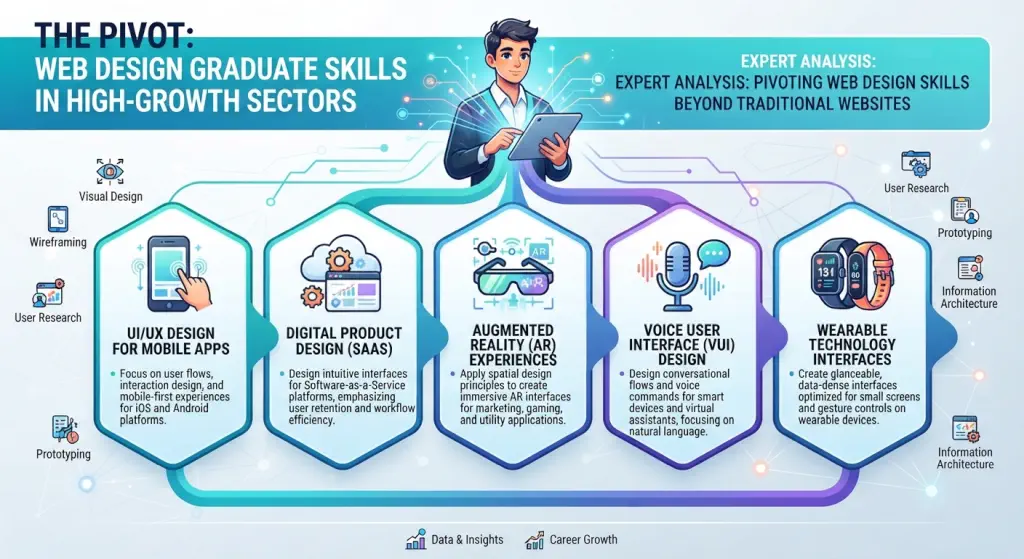
SILICON VALLEY – As the latest cohort of university students crosses the stage to receive their Bachelor’s degrees in Web Design, a common question arises from both graduates and recruiters: Is the title of “Web Designer” too narrow for the modern economy?
While the core curriculum of a Web Design degree focuses on HTML, CSS, JavaScript, and visual aesthetics, the underlying competencies—problem-solving, user psychology, and digital architecture—are currently in high demand across a staggering variety of industries.
In this expert analysis, we examine how the modern web design graduate can pivot their skills into five high-growth sectors that extend far beyond traditional website creation.
1. The Financial Technology (FinTech) Revolution
The banking and finance sector has undergone a massive digital transformation. Banks are no longer just brick-and-mortar institutions; they are software companies. Graduates with a background in web design are being aggressively recruited as User Experience (UX) Researchers and Product Designers within FinTech.
“In finance, it’s not just about a pretty interface; it’s about building trust through seamless navigation,” says Dr. Irina Rossi, a digital strategist. “A web design graduate understands how to structure complex information (Information Architecture), which is vital for trading apps and digital banking platforms where a single confusing button can cost a user thousands of dollars.”
2. E-Commerce and Conversion Rate Optimization (CRO)
As retail continues its migration to the cloud, companies are looking for more than just a digital storefront. They need specialists who can analyze consumer behavior. Web design graduates are finding lucrative roles as Conversion Rate Optimization (CRO) Specialists.
In this sector, the focus shifts from “How does it look?” to “How does it perform?” By using A/B testing and heatmaps—skills often touched upon in advanced design degrees—graduates can help brands like Amazon, Shopify, or independent retailers turn casual browsers into paying customers.
3. EdTech and Instructional Design
The global shift toward remote learning has created a vacuum for high-quality digital educational materials. Educational Technology (EdTech) firms are hiring web design graduates to serve as Instructional Designers.
These professionals take pedagogical content and transform it into interactive, web-based learning modules. The ability to design responsive, accessible, and engaging interfaces makes these graduates the perfect bridge between educators and students.
4. Data Visualization in Big Tech and Journalism
We live in an era of “Big Data,” but data is useless if it cannot be understood. This has birthed a massive demand for Data Visualization Designers.
Web design graduates are uniquely positioned for this because they understand both the technical side (SVG, Canvas, D3.js) and the design side (color theory, hierarchy). From newsrooms like The New York Times to corporate analytics departments at Google, the ability to turn a massive CSV file into an interactive, web-based infographic is a high-value skill.
5. The “Internet of Things” (IoT) and Smart Hardware
As our refrigerators, cars, and thermostats become connected to the internet, they require interfaces. While these aren’t “websites” in the traditional sense, they rely on the same principles of web technologies.
Graduates are finding roles as HMI (Human-Machine Interface) Designers in the automotive and home automation industries. “The transition from designing for a 15-inch laptop to a 4-inch smart-fridge screen is a natural move for a web designer,” notes tech recruiter Sarah Jenkins. “It’s all about responsive design and understanding the constraints of the hardware.”
The Expert Verdict: A Degree Without Borders
The Bachelor’s degree in Web Design is no longer a one-way street to a creative agency. It is a foundational degree in Digital Literacy.
For the recent graduate, the advice is clear: Don’t search for “Web Designer” on job boards. Look for “Product Designer,” “Interaction Designer,” “Frontend Developer,” or “Digital Strategist.” In a world that is digital-first, the person who knows how to build the doorway to the digital world—the interface—is a person who can work in almost any sector they choose. The browser was just the beginning; the entire digital infrastructure is now their playground.